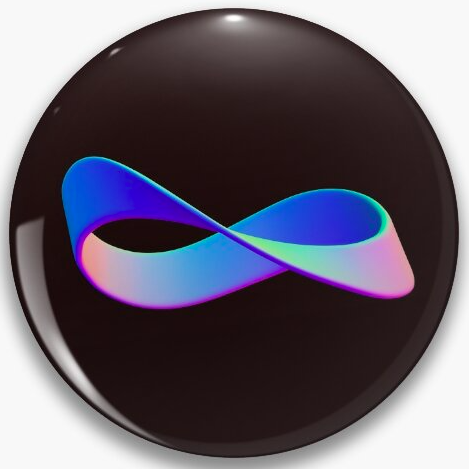
This model is based on observed phenomena, electron-positron collision results, and theory as explained below.
I (B. Vincent Crist) devised this model in 2005 while studying magnetic fields with my friend R. Joshi.

Electron (Anti-Positron) is Chiral, with Spin Structure of +1/2
(c) 2025 All rights reserved, B. Vincent Crist, PhD
NOTE: I am busy adding proper references and making my own figures or buying copyrights to figures I can not reproduce.
Positron (Anti-Electron) is Chiral with Spin Structure of -1/2

(c) 2025 All rights reserved, B. Vincent Crist, PhD
I claim that the shape of the electron is that of a Mobius Structure, and that the “s” atomic orbital also exists as a Mobius Structure. They both exist in the shape of a Mobius Structure that occupies 3 D space.
The Mobius Electron has chirality that is due to the Mobius structure. This structure is connected to or defines the electric and magnetic fields of the electron.
The electron has a mirror particle known as a positron or anti-electron which is trapped inside the nucleus until it is freed. The positron has the opposing mirror chirality.
This fact explains some of phenomena associated with the “s” orbital. Related structures that should be used for “p’, “d”, and “f” atomic orbitals are knot-based chiral structures that eliminate the need to invoke QM tunneling.
Shape of a Mobius Electron
If we could freeze a single electron by removing all its energy we would see the Mobius shape (a Torus shape) of the electron.
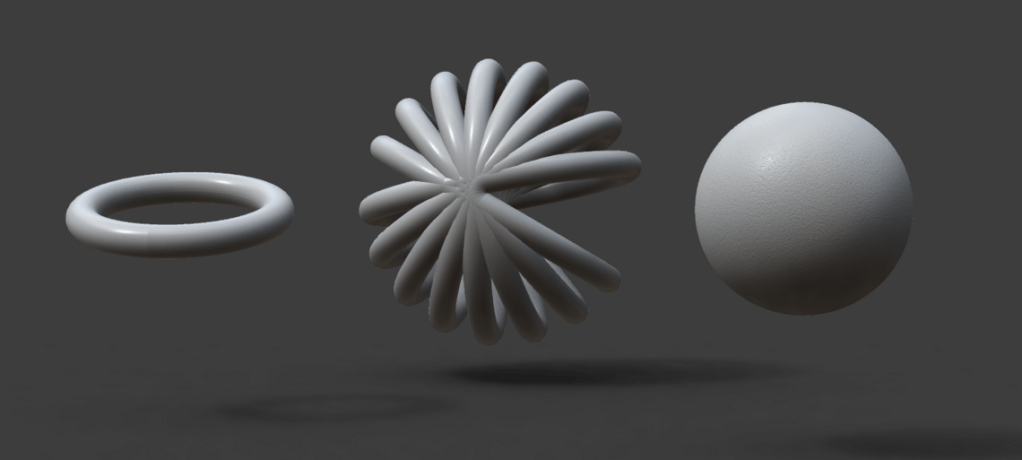
Sadly, no one has managed to freeze an isolated electron despite the fields applied. The reason is most likely due to Continuous Absorption-Emission of all EM, even super long radio-waves which exist throughout all space. These continuous absorption-emission super long radio-waves are the reason that it is so difficult to freeze out one isolated electron.
Because each electron in an atom, or flying through “empty” space as a truly free electron, has minimum rotational energy, the Mobius shape twirls and rotates so that it appears to be a nearly spherical ball, maybe with an shape of a typical orange or our planet Earth.
What I realized after studying SLAC experiments on annihilation experiments is that the classic radius is roughly 10(-12) and then some collision tests indicated a 10(-15) radius and then a 10(-18) radius if not smaller.
The 6 fold difference between the classic and the 10(-18) value is huge. MY thinking let me to consider that the higher kinetic energy of the electron together with its velocity was able to pass through the hole in the Mobius shape indicating the 10(-18) radius, while the mid-range size indicated that the impinging electrons could not see or penetrate the hole because the rotational velocity was too great mixed in with the electron-electron field repulsion that is extends beyond the electron volume in space.
Then there is the magnetic field that is a weaker force but is roughly 6x larger in volume that adds to repulsive field surrounding the electron that is the target.
Depiction of The Crist Theory for a Mobius Shaped Electron and their Pseudo Spherical shape
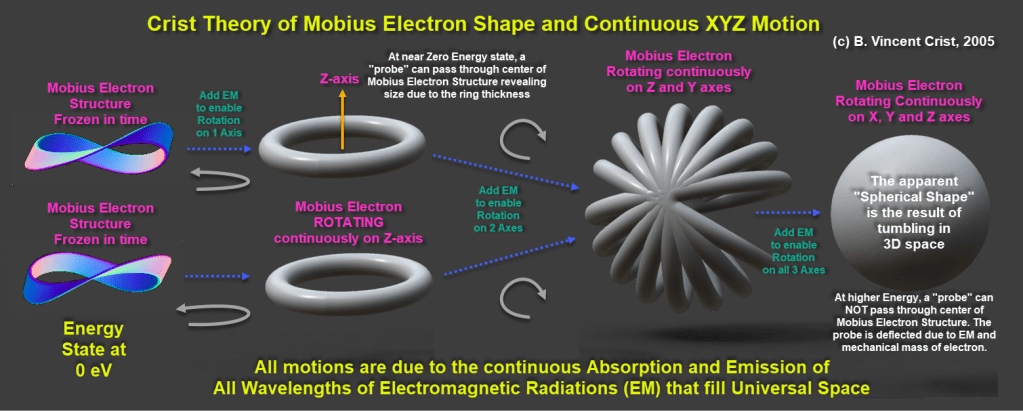
What is odd, is physicists depend on the Collision Experiments of colliders that collect such a massive amount of data that it is probable the timeframe to catch a rare “Penetration” is too small. Too many competing collisions that blur the other effects.
There is also the continuous nature of the Mobius “structure” that exhibits both “electric field” and “Magnetic field” properties (behaviors) as we call them. I think the “kink” is the source of the electric nature and the smooth remaining structure should be associated with the magnetic nature of the electron.
I have in mind a cross-sectional view of the electron but will put that in another page.
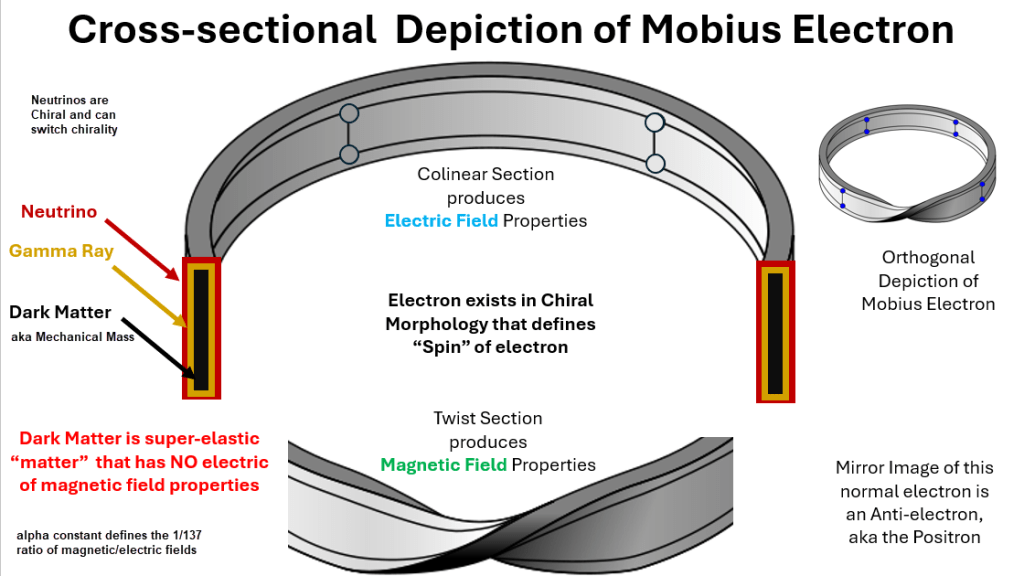
I think that Quasars or Neutrino stars actually produce electrons by combining a chiral Neutrino, with a Gamma Ray photon (wave), and my super-elastic “Darkon” which is composed of only “dark mechanical matter”. The 3 components “weigh” less than a single electron on the energy scale.
The 3 components (particles?) can form “electrons” within the sphere of Quasars or Neutrino stars and form the plasma spheres around those stars and perhaps “Black Holes” as well.
Another piece of the particle puzzle involves the combination of electrons to form Quarks, Muons, etc. This combination behavior is simple. Linear combinations (Strings?) of 2 electrons to form a one of the Quarks. 3 electrons to form a different Quark etc.
This sequential combination of “damaged” electrons produces particle “couples” that have strange energies and behaviors.
In my thinking, Protons are a set of 3 electrons in the shape of Trefoil
And there are 4 electrons in a Neutron.
 Mobius Shaped Electrons